
Projects and Research
Here is a brief introduction to Research Projects and DIY tools I have developed.
Active Flow Control : Plasma Actuators
The interaction of a rotating conical flow with a solid surface generates a centrifugal instability. This occurs in the flow over the wings of certain types of aircraft at high angles of attack. Efforts at our laboratory have detected such structures using near-surface flow diagnostics, and shown that they can be effectively alleviated using passive flow control near the surface. Their alleviation removes the narrowband spectral peak at the nominal location of vertical fins on these aircraft. This project explores the substitution of active flow control techniques that remain conformal to the surface and are only powered during high angle of attack operation. The occurrence of the phenomenon and its 15-dB alleviation with geometric fences are shown on a rounded-edge 42-degree swept, cropped delta wing at 25 degrees angle of attack. The feasibility and power requirements for the plasma actuator are estimated in this paper. The generation of counter-rotating vortices using a double dielectric barrier discharge actuator is demonstrated.
Publications:
Kumar, Vaibhav, et al. "Control of Centrifugal Instability in Vortex-Surface Interaction." ASME International Mechanical Engineering Congress and Exposition. Vol. 57342. American Society of Mechanical Engineers, 2015.
Kumar, Vaibhav, et al. "Dielectric Barrier Discharge Actuators to Control Goertler Vortices on a Swept Wing." Fluids Engineering Division Summer Meeting. Vol. 50282. American Society of Mechanical Engineers, 2016.
Thorell, Nikolaus, Vaibhav Kumar, and Narayanan Komerath. Yaw Effects on the Narrowband Spectra Above a Delta Wing in Turbulent Flow. No. 2016-01-2056. SAE Technical Paper, 2016.
Elevator Pitch:
Active Noise Control : Acoustic Liners
The present work explores the feasibility of controlling the acoustic impedance of a resonant type acoustic liner. This will be accomplished by translating one perforate over another of the same porosity creating a totally new perforate that had an intermediate porosity. This type of adjustable perforate created a variable orifice perforate whose orifices were non-circular. This arrangement also forms a stepped geometry in the transverse direction, referred to here as a stepped oval orifice. The key objective of the present study is to quantify the degree of attenuation control that can be achieved by using such a concept on the buried septum in a two-degree-of-freedom acoustic liner. Different orifice shapes with the same area will also be examined to determine if highly non-circular orifices had a significant impact on the impedance.
Publications:
Kumar, Vaibhav, et al. "Control of Acoustic Impedance of a Resonant Liner by Varying Orifice Geometry through Multi-Layer Sliding Perforates." 2018 AIAA/CEAS Aeroacoustics Conference. 2018.
Elevator Pitch:
Instabilities in Microjets
In this project, high speed imaging techniques were used to map instabilities at different pressure ratios for different micronozzles.Testing was done with micronozzles of different diameter of the order of 50-1000 micrometers. Desired pressure ratios were achieved with a driver pressure pump (max: 5bar) upstream of the nozzle and a vacuum pump downstream of the nozzle. Different kinds of instabilities were measured, including some anomalous instabilities that are the topic of current research.
Elevator Pitch:
Pending Publication
Experimental Setup
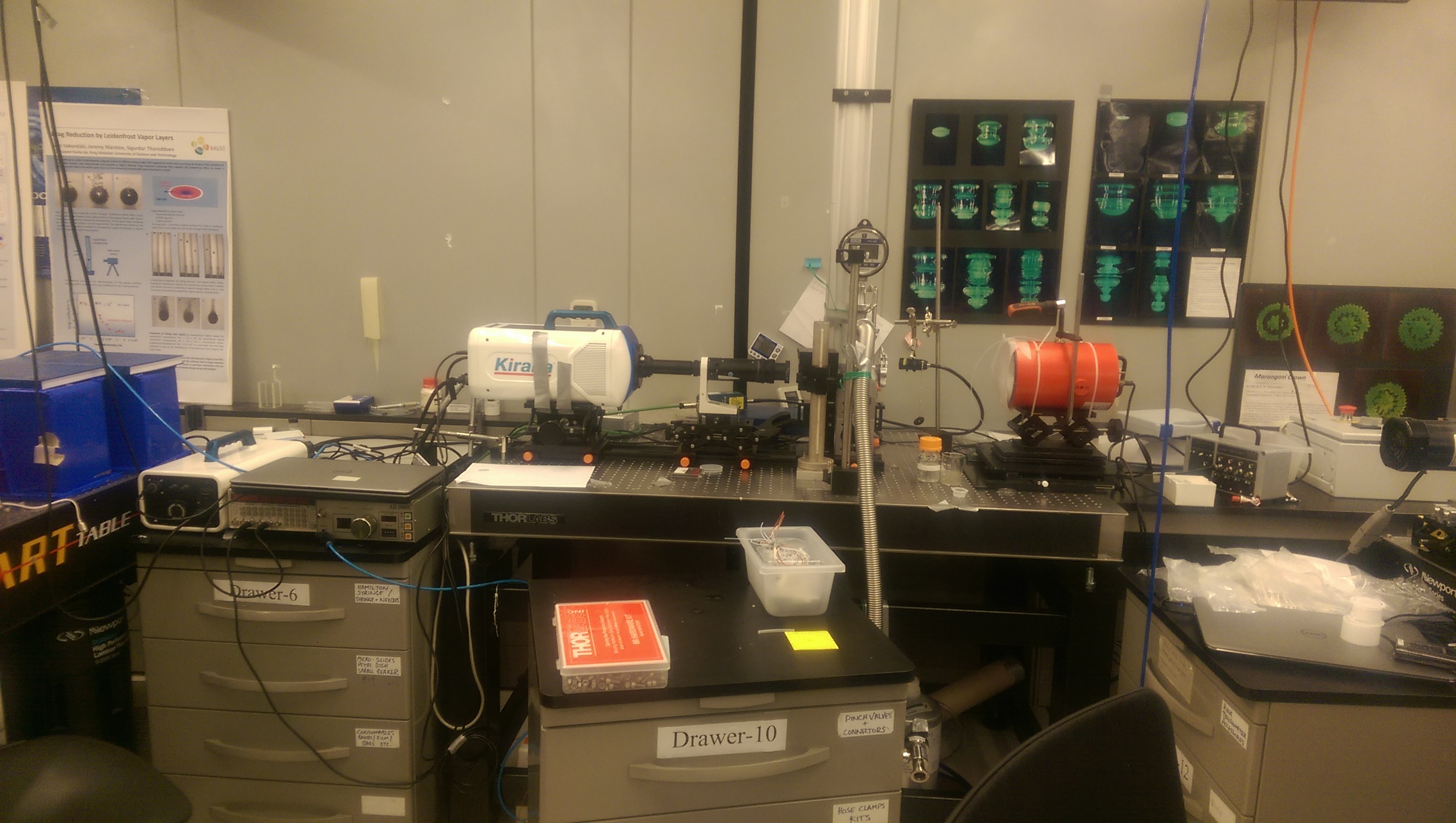
Tomo-PIV for turbulence statistics of flow through a contraction
In this project, I assisted a PhD student studying turbulence statistics in developing an experimental facility for tomographic Particle Image Velocimetry. In general terms, Tomographic PIV allows us to map velocity vectors using a Lagrangian Approach in three dimensions. Unlike PIV and Stereo-PIV, Tomo-PIV requires a reconstruction of 3D particle distribution using DaVis' proprietory reconstruction algorithm(MART) prior to 3D cross-correlation. The usage of MART narrows down the tolerances in calibration of the multiple views making this a very challenging velocimetry technique.Data has been acquired and is pending approval for publication.
Spectator Views of the Technique:
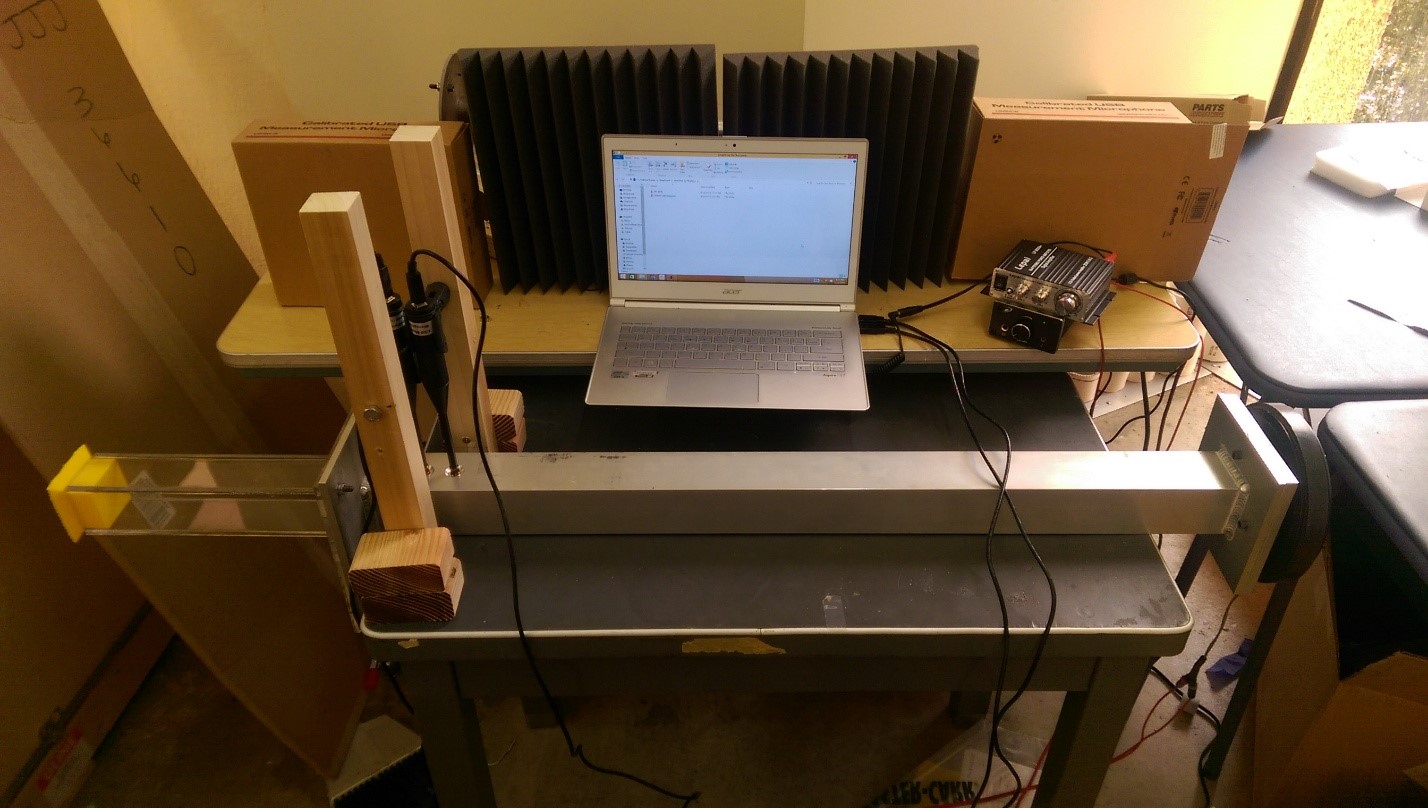
Development of a Turnkey Impedance Tube using the 2 microphone method.
Impedance in acoustics is the measure of the opposition that a system presents to acoustic flow resulting of an acoustic pressure applied to the system. It indicates how much sound pressure is generated by the vibration of molecules of a particular acoustic medium at a given frequency. The knowledge of the impedance of a material is essential for the design and development of acoustic materials. In this special project, a low-cost turnkey square impedance tube was developed for measurement of surface impedance and absorption coefficient using the two microphone method. The tube was designed to satisfy the driving requirements for experiments to be conducted in the coming semesters and was developed using in-house prototyping tools and facilities. Development of the tube involved the design and development of the tube hardware as well as software for data processing. The measurement capabilities of the tube have been qualitatively verified using baseline ‘impedance tube controller’ software used at GTRI-ATAS and using theoretical predictions for rigid wall boundary condition.
Experimental Setup:
Design Build Fly : Fixed Wing Sizing
This excel sheet is the perfect first order analysis tool for building a model RC airplane. The design derives from mission requirements which are payload and total endurance (doesn't assume a flight profile). The design is not-iterative in nature but allows for iteration based on endurance and AUW convergence. Weight buildup is based on foam-board (prefilled density that is changeable) and not balsa as I find foamboard easier to work with. The sizing code accounts for Roll, Yaw and Pitch stability based on usual/acceptable values of stability margins and volume coefficients. Damping coeffecients are not considered here. The Prop-sizing code has been copied from Gabriel Staples empirical work on Propeller sizing. The code assits in calculation of the optimal motor, propeller diameter and pitch, battery requirement and size of each control surface and componenent to meet the mission requirements and maintain static stability in all three axes.
Dropbox link to Excel Sheet
Design Build Fly : Multicopter Sizing
This excel sheet is the perfect first order analysis tool for building a multicopter RC drone. The design derives from mission requirements which are # of rotors, payload capacity, Hover endurance and Propeller diameter. The design code assumes a generic mass breakdown and Thurst to Weight ratio based on published empirical formulations for quadcopters in the same weight class. The design is non-iterative in nature but allows for easy iteration based on endurance and AUW convergence. The code doesn't account for vehicle stability criterions. While the code assists in calculation of optimal Propeller diameter and pitch and motor kV and power loading, it does depend on the user to find suitable commercial motors that meet the criterions.
Dropbox link to Excel Sheet
Atmospheric Acoustic Attenuation
This MATLAB code solves for the atmospheric attenuation between two points in space. The code is based on Sutherlands 19773 model of attenuation and follows ASA S1.26. The code also allows for "mean atmosphere" values of pressure and temperature as a function of geopotential altitude to calculate attenuation at altitude. Additionally, the code also provides error bounds for calculated attenuation values based on known empirical attenuation coefficients.
Dropbox link to MATLAB code
Two-Microphone Method
The two microphone method is a popular standardized technoque for determining the normal aoustic impedance of materials. In this method, an acoustic river is mounted at one end of an acoustic waveguide, and the test speciimen is mounted at the other.Two microphones are flush mounted in the duct wall to determine the incident and reflected waves. The microphone data is used to estimate the complex reflection coefficient and the corresponding acoustic impedance of the test specimen. Correlation component of this code was written by Shane Lympany.
Dropbox link to MATLAB code
Rotor Acoustics
With the advent of electric VTOL concepts, acoustics becomes an important design criterion for vehicle designers.To faciliate VTOL activies in urban environments, designers will have to incoporate noise dampening technologies to reduce the acoustic footprint of their vehicles. This excel sheet gives a quick SPL vs Frequency plot for the given rotor and thrust loading parameters. The code models both narrowaband rotor rotational noise at harmonics of BPF and broadband vortex noise at higher frequencies.